Porcelain vs sandstone in Hertfordshire clay
Two good materials, one honest comparison — and why, on Hertfordshire's shrink-swell clay, what's under the slab decides everything.
7 min read · Reviewed 1 July 2026
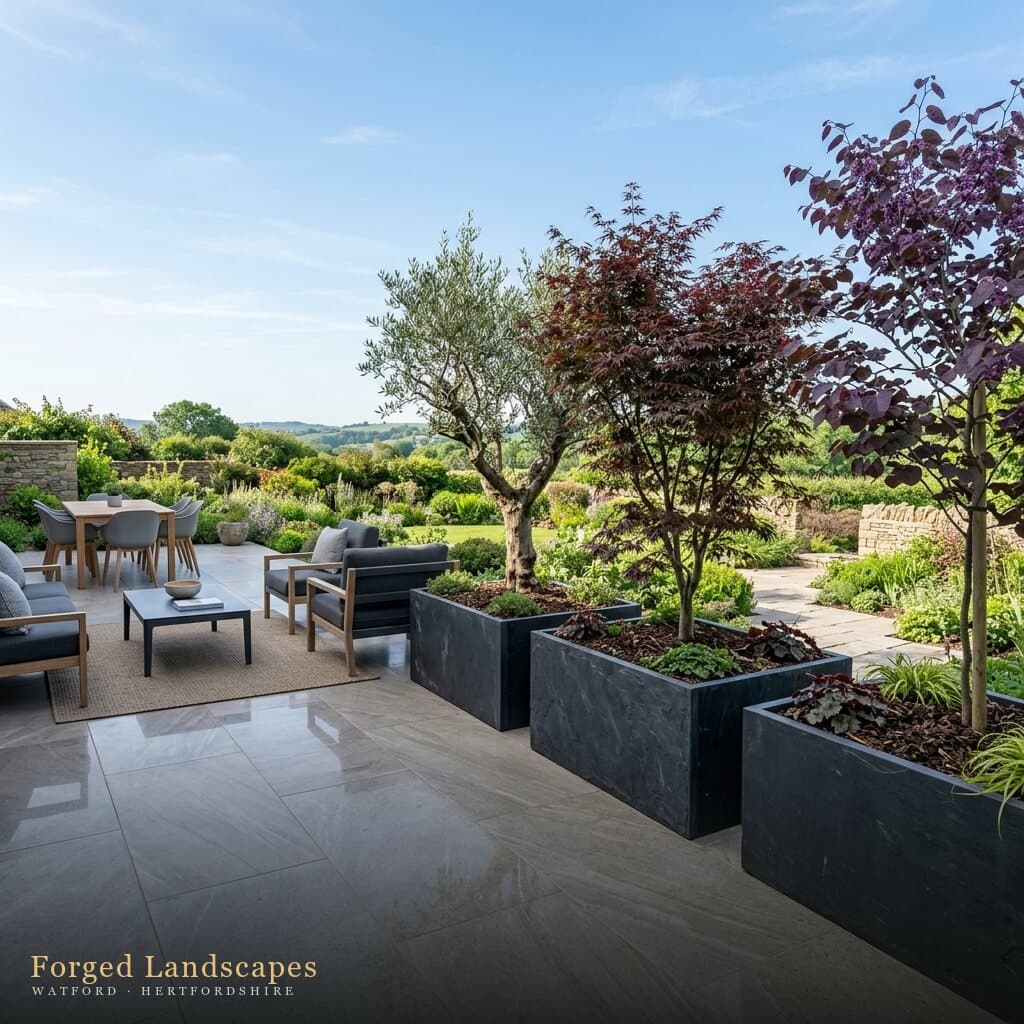
Porcelain and natural sandstone are both excellent patio materials, and the choice between them is more about the look you want and how you like to live than about one being 'better'. But there's a bigger factor most comparisons skip, and in Hertfordshire it matters more than the slab itself: the ground you're building on.
The honest difference in the surface
Porcelain is a vitrified, near-zero-porosity slab, usually 20mm thick. It's frost-proof, stain-resistant and colour-stable — it looks the same in year ten as day one — and it wants almost no maintenance. The look is crisp and contemporary, and the textured finishes grip well in the wet. It costs more per square metre, and it demands more skill to lay: slabs are primed with a slurry, cut with the right blade, and set precisely because there's no 'natural variation' to hide a wandering line.
Indian sandstone is a natural stone, typically 22mm calibrated. It's warmer, more varied and it patinas with age into something softer and more traditional. It's more porous, so it takes a sealer and, in permanent shade, can host algae that needs an occasional wash. It's kinder on the budget and more forgiving to lay. Where a garden wants character and warmth rather than crisp minimalism, sandstone earns its place.
Why the base matters most on clay
Here's the part that decides whether either material still looks right in five years. Much of Hertfordshire sits on shrink-swell clay — ground that expands when wet and contracts as it dries, moving seasonally. A patio laid badly on clay lifts, rocks and cracks regardless of whether the slab on top cost £15 or £150.
A patio fails at the base, never at the surface. Ours go down on a minimum 100–150mm of compacted MOT Type 1 sub-base, over a full wet mortar bed with the slabs primed — not spot-bedded on five dabs of mortar, which is where the hollow, rocking, cracking slabs you've seen at friends' houses come from. Falls are set at 1:60 to 1:80 so water leaves the surface and heads away from the house, and a flexible jointing compound absorbs the small seasonal movement instead of fighting it.
The rule of thumb
Spend your decision on the look, but never let anyone save money on the base. On clay, a proper sub-base and full mortar bed is the difference between a patio that outlasts the house and one that needs relaying by year three.
Cost, as a guide
For planning purposes: a porcelain patio supplied and laid runs from around £190/m²; Indian sandstone from around £150/m². The gap is mostly the material and the extra laying time porcelain needs. These are guide figures — levels, access, steps and groundworks all move the number, which is why a survey produces a fixed, itemised quote rather than a rate.
So which one?
Porcelain if you want low-maintenance, colour-stable and crisp — especially in a modern scheme or a shady garden where you'd rather not manage algae. Sandstone if you want warmth, character and a softer, aged feel, or you're balancing a bigger project against budget. We bring full-size samples to the survey and lay them down in your actual light — never choose paving from a website swatch or a showroom's LED strip.
Asked often
Straight answers
Textured, capped porcelain is generally better in the wet than smooth natural stone, and far better than sandstone that has grown algae in the shade. Whichever you choose, the falls we build in mean the surface sheds water rather than holding it, which is what actually keeps a patio safe underfoot.
No — porcelain's near-zero porosity makes it frost-proof, so it won't spall or crack from cold. What cracks any paving is a failing base: movement in the ground telegraphs up through slab and joint alike, which is why the sub-base and mortar bed matter more than the material.
Natural sandstone should be sealed, and we seal it as standard; it benefits from re-sealing every few years. Porcelain does not need sealing at all — its surface is effectively non-absorbent, which is a large part of why it's so low-maintenance.
Clay soil swells when wet and shrinks when dry, moving seasonally. If a patio is spot-bedded or laid on a thin sub-base, that movement lifts and cracks it. A 100–150mm compacted sub-base, full mortar bed and flexible jointing absorb the movement — which is why the groundwork, not the slab, is the real investment.
From guide to garden
Three questions, a postcode check, and a proper plan.
No obligation, no pressure — just a clear next step whenever you're ready.
Related services